Black Sea: Countries, Map and Montreux Convention for UPSC
UPSC Planner Editorial Team
Summary
Six countries border the Black Sea: Ukraine, Russia, Georgia, Turkey, Bulgaria and Romania. It reaches the Mediterranean through the Bosporus, the Sea of Marmara and the Dardanelles, and the 1936 Montreux Convention governs ship passage through those straits.
Six countries border the Black Sea: Ukraine, Russia, Georgia, Turkey (Türkiye), Bulgaria and Romania. The sea is almost enclosed by land. Its only link to the world's oceans is the Bosporus, which leads through the Sea of Marmara and the Dardanelles to the Mediterranean, and a 1936 treaty, the Montreux Convention, governs passage through those straits. UPSC tests this topic through map questions (which countries border it, where the straits lie), static geography (rivers, layers of water) and treaties.
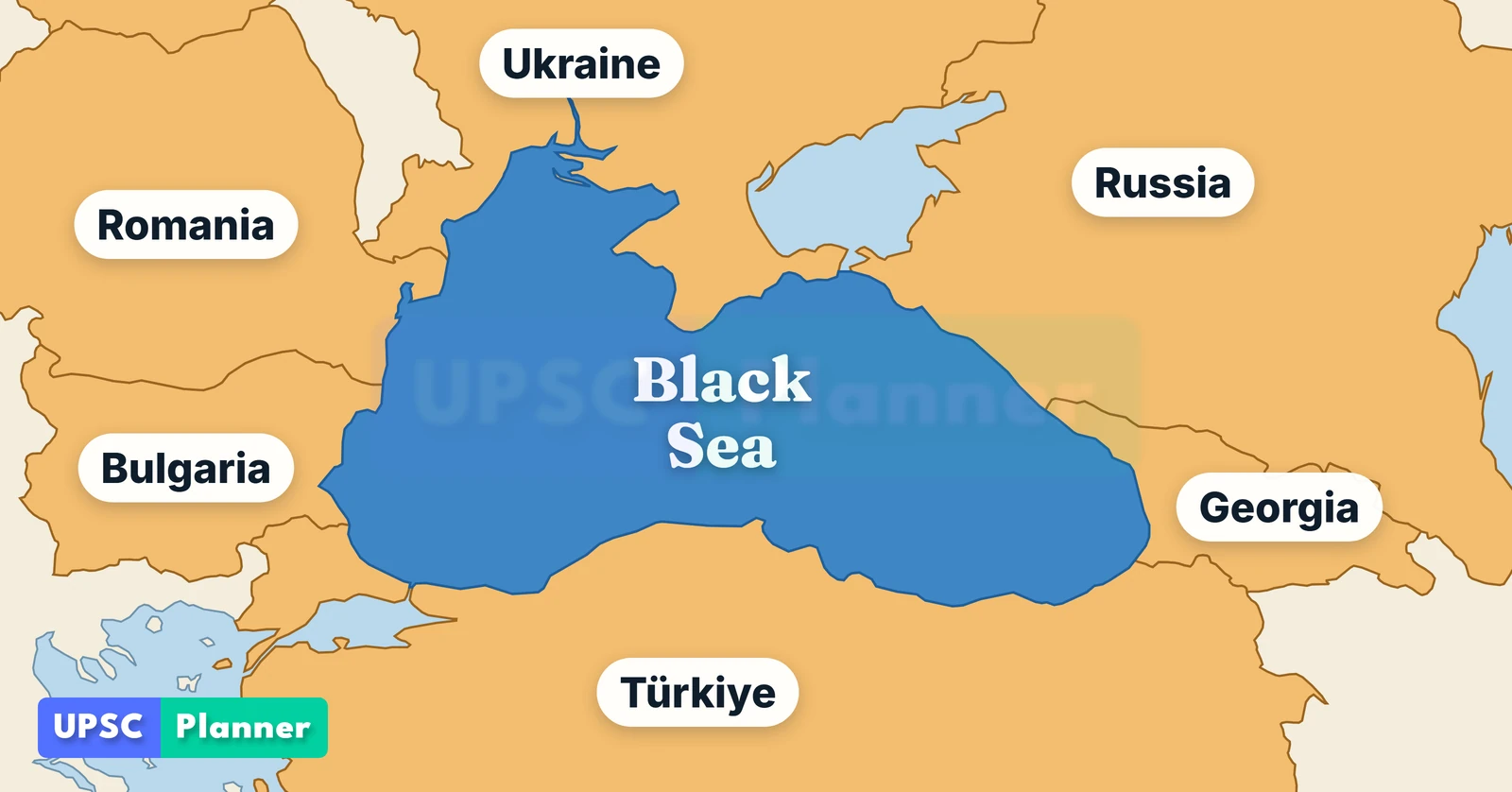
Map: UPSC Planner. Base map data: Natural Earth (public domain).
Which countries border the Black Sea?
The Black Sea has six littoral states. A littoral state is a country with a coast on that body of water.
| Country | Capital | Position on the Black Sea coast |
|---|---|---|
| Ukraine | Kyiv | North |
| Russia | Moscow | North-east |
| Georgia | Tbilisi | East |
| Turkey (Türkiye) | Ankara | South |
| Bulgaria | Sofia | West |
| Romania | Bucharest | North-west |
The 2007 Black Sea Transboundary Diagnostic Analysis, prepared under the Black Sea Commission, lists the same six coastal countries: Bulgaria, Georgia, Romania, the Russian Federation, Turkey and Ukraine. Turkey asked the United Nations in 2022 to use the name Türkiye, so you will see both spellings. The Black Sea covers about 423,000 square kilometres and is over 2 km deep, according to the same report.
How is the Black Sea connected to the Mediterranean?
The sea is almost cut off from the oceans. Its only connection is the Bosporus Strait, a natural channel about 35 km long, which links it to the Sea of Marmara. The Sea of Marmara in turn connects to the Mediterranean through the Dardanelles. The Montreux Convention names the three together: the Straits of the Dardanelles, the Sea of Marmara and the Bosphorus ("Straits" in the treaty).
The Bosporus has a two-layer flow: saltier Mediterranean water moves north along the bottom, while a mixture of seawater and fresh river water flows out above it.
What is the Montreux Convention of 1936?
The Convention Regarding the Regime of the Straits was adopted at Montreux, Switzerland, on 20 July 1936. It replaced the 1923 Lausanne arrangements and regulates transit and navigation through the Dardanelles, the Sea of Marmara and the Bosporus within the framework of Turkish security and the security of the Black Sea states. These are the rules most often asked:
| Rule | What the treaty says | Article |
|---|---|---|
| Freedom of transit | The parties affirm the principle of freedom of transit and navigation by sea in the Straits | Article 1 |
| Merchant ships in peace | Complete freedom of transit, by day and night, under any flag and with any cargo, without formalities beyond sanitary control | Articles 2 and 3 |
| Notice for warships | Normal notice to Turkey is eight days; fifteen days is desirable for non-Black Sea powers | Article 13 |
| Foreign warships in transit | Not more than 15,000 tons in aggregate and not more than nine vessels at one time | Article 14 |
| Non-Black Sea powers in the Black Sea | Aggregate tonnage limited to 30,000 tons, rising to at most 45,000 tons; one such power limited to two-thirds of that total | Article 18 |
| Length of stay | Warships of non-Black Sea powers may not stay in the Black Sea more than 21 days | Article 18 |
| War, Turkey neutral | Warships of non-belligerent states keep freedom of passage; warships of belligerents may not pass, with listed exceptions | Article 19 |
| War, Turkey a belligerent or in imminent danger | Passage of warships is left to the discretion of the Turkish government | Articles 20 and 21 |
| Duration | The convention ran for twenty years, but the principle of freedom of transit and navigation continues without limit of time | Article 28 |
Turkey's Ministry of Foreign Affairs says Türkiye has implemented the Convention since 1936. It also states that aircraft carriers cannot pass through the Straits, and that only submarines of Black Sea states may pass, in limited cases such as returning to base or repair.
Which rivers flow into the Black Sea?
About 350 cubic kilometres of river water enter the sea every year from a basin covering almost a third of continental Europe. The 2007 analysis notes that Europe's second, third and fourth largest rivers, the Danube, Dnieper (Dnipro) and Don, all flow to the Black Sea.
The Danube reaches the sea through the Danube Delta. According to the International Commission for the Protection of the Danube River (ICPDR), the greater part of the delta lies in Romania, and its northern part, on the left bank of the Chilia arm, lies outside Romania, in Ukraine. The Danube is the second-longest river in Europe after the Volga.
Why is the Black Sea less salty than the oceans?
Large rivers keep pouring fresh water into a sea that is almost closed to the open ocean, so its surface water is much less salty than the oceans'. The saltier Mediterranean water that enters through the Bosporus stays below, because it is denser.
Why is most of the Black Sea's deep water without oxygen?
The fresher surface layer sits on top of the denser, saltier bottom water and the two hardly mix. Oxygen from the surface does not reach the depths, so the deep water is anoxic (it contains no oxygen) and holds hydrogen sulphide. The 2007 analysis says some 90% of the sea is naturally anoxic, while the top 150 metres is very productive. Other studies give the anoxic share as about 87%, so remember "most of it" rather than one figure.
Which treaty protects the Black Sea from pollution?
The Convention on the Protection of the Black Sea Against Pollution, called the Bucharest Convention, was signed on 21 April 1992 in Bucharest by the six coastal states and entered into force on 15 January 1994. It created the Black Sea Commission, with a permanent Secretariat in Istanbul, which Türkiye has hosted since December 2000.
High-yield points for UPSC Prelims
- Six littoral states: Ukraine, Russia, Georgia, Turkey (Türkiye), Bulgaria, Romania.
- Only link to the world's oceans: the Bosporus, then the Sea of Marmara, then the Dardanelles, then the Mediterranean.
- Montreux Convention, 20 July 1936: governs passage through these straits; Turkey has the central role.
- Merchant ships have free passage in peacetime. Warship rules depend on whether the state is a Black Sea power.
- Non-Black Sea warships: at most 21 days in the Black Sea, with tonnage limits under Article 18.
- The Danube, Dnieper and Don flow to the Black Sea; the Danube delta is mostly in Romania.
- Most of the sea's water is naturally anoxic; the top 150 metres is the productive layer.
- Bucharest Convention: signed 21 April 1992, in force 15 January 1994.
Sources
Facts on this page were checked against the sources below on 9 November 2026.
- Convention Regarding the Regime of the Straits (Montreux, 20 July 1936), full text: preamble and Articles 1, 2, 13, 14, 18, 19, 20, 21 and 28. This is an unofficial English text published by the NUS Centre for International Law.
- Ministry of Foreign Affairs of Türkiye: Implementation of the Montreux Convention.
- Ministry of Foreign Affairs of Türkiye: Bucharest Convention.
- Black Sea Transboundary Diagnostic Analysis (May 2007): coastal states, Bosporus connection, river inflow and anoxic share.
- ICPDR: Danube River Basin: the Danube and its delta.
- Euronews: Turkey asks the UN to use "Türkiye" (2 June 2022).
Practise what you read
Test your geography with UPSC Geography MCQs on UPSC Planner.