Sample MCQs

Try these questions, then start the full collection for instant feedback.

1. What is the primary focus of Social Science as a field of systematic inquiry?

  1. A.The study of physical and chemical reactions in nature
  2. B.The exploration of abstract mathematical formulations exclusively
  3. C.The systematic study of human society, institutions, cultures, and interconnections
  4. D.The biological classification of flora and fauna

2. In Indian philosophical traditions, what does the concept of 'Pañchamahābhūtas' represent?

  1. A.Five fundamental elements (earth, water, fire, air, space) explaining nature as an interconnected system
  2. B.Five stages of administrative revenue collection in ancient kingdoms
  3. C.Five sacred canonical texts of early classical literature
  4. D.Five historical dynasties that governed the northern plains

3. Which ancient Indian philosophical maxim translates to 'the world is one family', expressing global interdependence and interconnectedness?

  1. A.Satyameva Jayate
  2. B.Ahimsa Paramo Dharmah
  3. C.Sarve Bhavantu Sukhinah
  4. D.Vasudhaiva Kuṭumbakam

Choose a chapter

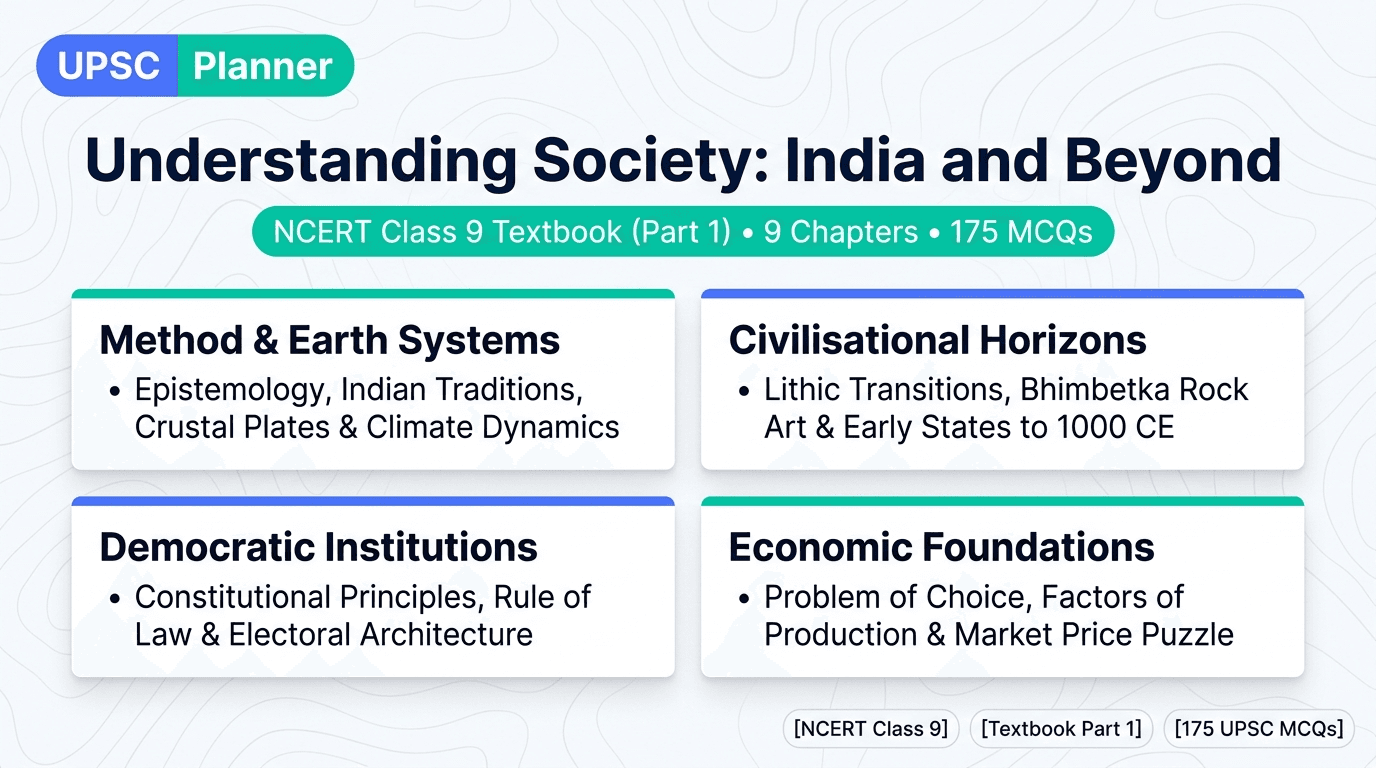
9 chapters available for practice.

📋 chapter

NCERT Class 9 Chapter 1: Understanding Social Science MCQs

Practice MCQs on disciplines of social science, Indian knowledge traditions, Panchamahabhutas, Arthashastra, and historical sources from NCERT Class 9 Chapter 1.

Open collection

📋 chapter

NCERT Class 9 Chapter 2: Shaping of the Earth's Surface MCQs

Practice MCQs on plate tectonics, Earth's internal layers, weathering, erosion, river/glacial/wind/karst landforms, and disasters from NCERT Class 9 Chapter 2.

Open collection

📋 chapter

NCERT Class 9 Chapter 3: Atmosphere and Climate MCQs

Practice MCQs on atmospheric composition, atmospheric layers, insolation, monsoon mechanisms, seasons of India, and climate change from NCERT Class 9 Chapter 3.

Open collection

📋 chapter

NCERT Class 9 Chapter 4: Early Humans and Beginning of Civilisation MCQs

Practice MCQs on human evolution, Stone Age stages, Mehrgarh, Sindhu-Sarasvati, Mesopotamian city-states, Egypt, and ancient China from NCERT Class 9 Chapter 4.

Open collection

📋 chapter

NCERT Class 9 Chapter 5: State and Society up to 1000 CE MCQs

Practice MCQs on Vedic political assemblies, Kautilya Saptanga theory, Gupta administration, Uttaramerur Kudavolai system, and early Indian guilds from NCERT Class 9 Chapter 5.

Open collection

📋 chapter

NCERT Class 9 Chapter 6: Democracy MCQs

Practice MCQs on democratic ethos, constitutional values, rule of law, PESA 1996, grassroots panchayats, and democratic forms from NCERT Class 9 Chapter 6.

Open collection

📋 chapter

NCERT Class 9 Chapter 7: Elections MCQs

Practice MCQs on FPTP vs PR-STV systems, ECI powers, Delimitation Commissions, RPA Acts, Anti-Defection Law, and national party criteria from NCERT Class 9 Chapter 7.

Open collection

📋 chapter

NCERT Class 9 Chapter 8: Building Blocks in Economics: The Problem of Choice MCQs

Practice MCQs on scarcity, opportunity cost, Production Possibility Curve, factors of production, and market vs planned economic systems from NCERT Class 9 Chapter 8.

Open collection

📋 chapter

NCERT Class 9 Chapter 9: The Price Puzzle: What Drives the Market MCQs

Practice MCQs on demand schedules, supply curves, market equilibrium, price ceilings, price floors, and economic regulators from NCERT Class 9 Chapter 9.

Open collection