chapter

NCERT Class 9 Chapter 7: Elections MCQs for UPSC

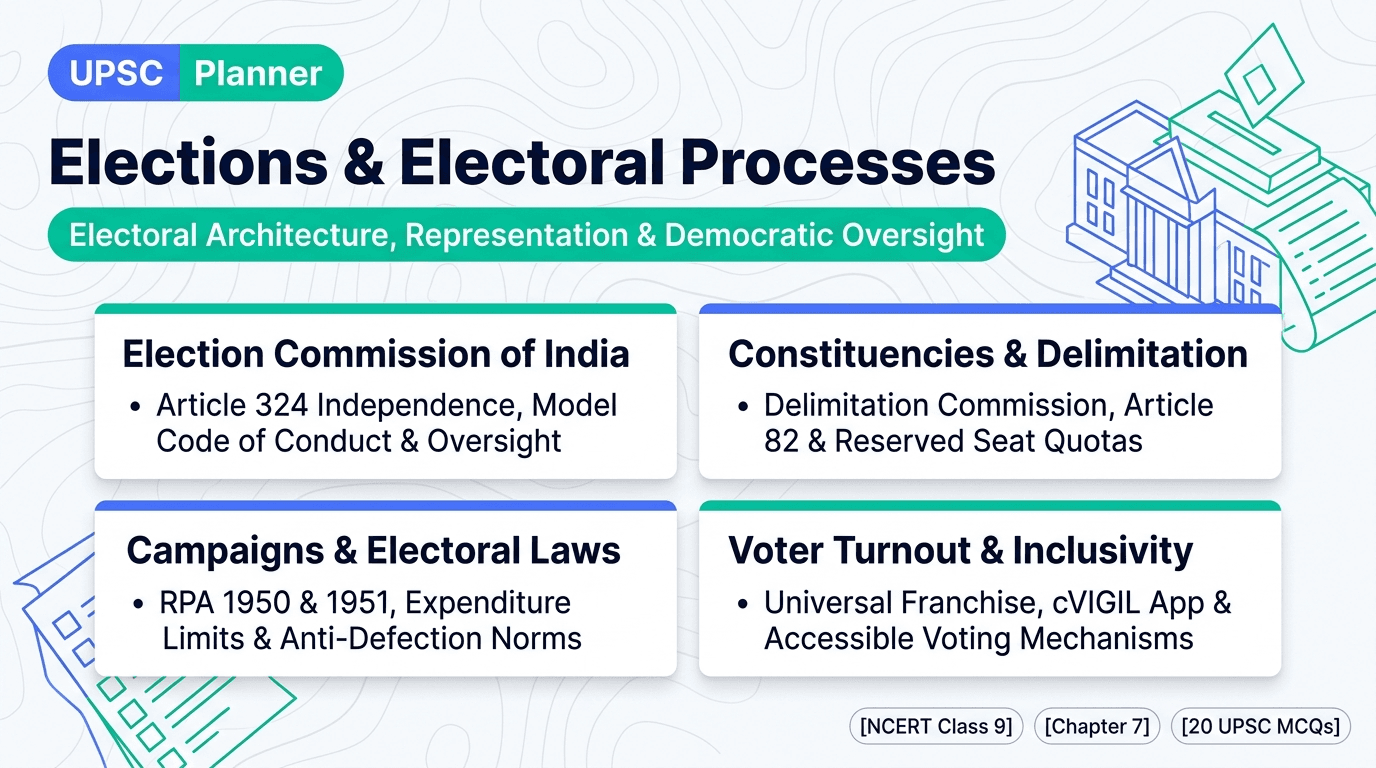
Master key electoral concepts from NCERT Grade 9 Chapter 7 including electoral mechanisms, election machinery, digital apps (cVIGIL, Suvidha), party recognition criteria, and democratic reforms.

20 questions in this collection

Previously attempted questions are skipped in practice mode.
Sample MCQs

Try these questions, then start the full collection for instant feedback.

1. In the Indian constitutional framework, which representative offices are elected through direct elections by citizens, and which through indirect elections?

  1. A.Direct elections: Lok Sabha, Vidhan Sabha, and local Panchayats; Indirect elections: President, Vice President, Rajya Sabha, and Vidhan Parishad
  2. B.Direct elections: President and Rajya Sabha; Indirect elections: Lok Sabha and Vidhan Sabha
  3. C.Direct elections: Vice President and Vidhan Parishad; Indirect elections: Panchayats and Municipalities
  4. D.All constitutional offices in India are filled exclusively through direct popular voting

2. What is the academic and scientific study of elections, voting behavior, and electoral trends called, and what is its etymological origin?

  1. A.Demography, derived from demos meaning population
  2. B.Psephology, derived from the Greek word psēphos meaning pebble
  3. C.Sociology, derived from socius meaning companion
  4. D.Polity, derived from polis meaning city-state

3. In which six Indian States does the state legislature possess a bicameral structure comprising both a Legislative Assembly (Vidhan Sabha) and a Legislative Council (Vidhan Parishad)?

  1. A.Tamil Nadu, Kerala, Rajasthan, Gujarat, Punjab, and Haryana
  2. B.West Bengal, Odisha, Assam, Jharkhand, Chhattisgarh, and Madhya Pradesh
  3. C.Andhra Pradesh, Bihar, Karnataka, Maharashtra, Telangana, and Uttar Pradesh
  4. D.Himachal Pradesh, Uttarakhand, Goa, Sikkim, Manipur, and Tripura